
Urban areas struggle with chronic congestion, high-energy street lighting, and declining air quality. IoT Shabaka deploys an integrated sensor-to-cloud architecture that synchronises traffic signals, dims or brightens LEDs in real time, and streams hyper-local environmental metrics. The platform ingests multi-source data, applies AI analytics, and issues automated control commands, creating a self-optimising urban fabric.
Solution Overview
Core Architecture & Components
Layer | Key Elements | Functionality |
|---|
Impact Area | Metric | Global Benchmarks |
|---|---|---|
O&M cost | ▼ 40 % lighting maintenance via predictive alerts (Barcelona pilot) | Automated fault detection planned under TASMU Transport use-cases |
Emissions | ▼ 10-12 % CO₂ from reduced idling (Singapore GLIDE analysis) | Projected 5 % GDP-linked gain from smart-city efficiencies by 2022 |
Energy use | ▼ 30 % lighting power cut after LED+IoT rollout (Barcelona) | Msheireb Downtown reports 30 % lower overall energy demand via 8 000 smart meters |
Traffic flow | ▲ 15-25 % faster average corridor speed (AI-signal coordination, Singapore) | ITS roadmap targets 20 % reduction in delays on Doha arterials (Ashghal) |
Quantified Benefits
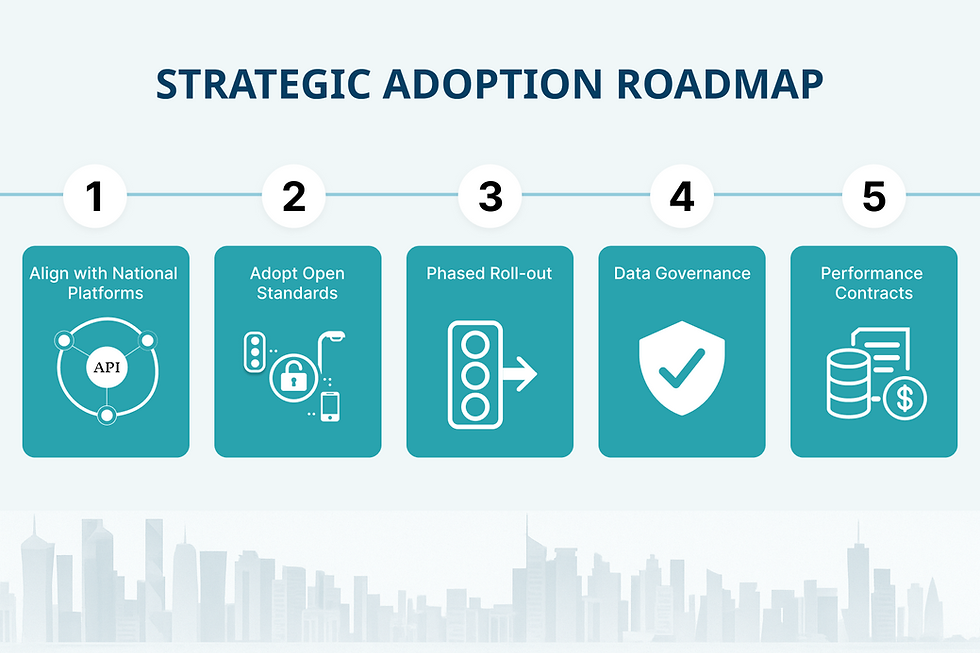
Strategic Adoption Roadmap
Deployment under this framework positions municipalities to exceed Qatar National Vision 2030 sustainability and mobility targets while delivering measurable economic return.
Align with National Platforms
Adopt Open Standards
Deploy ITS devices certified under Ashghal V&V guidelines to ensure interoperability and lifecycle security.
Prioritise high-congestion corridors for adaptive signal control, followed by district-wide smart lighting retrofits linked to demand-based dimming profiles.
Phased Roll-out
Enforce Qatar Cybersecurity Framework controls on all IoT endpoints; anonymise mobility data in accordance with Law (13) of 2016 on Personal Data Protection.
Data Governance
Structure energy-service agreements (ESPCs) that guarantee ≥25 % energy savings, financing CAPEX through realised utility reductions.
Performance Contracts
Integrate datasets through MCIT’s TASMU Smart Qatar backbone to leverage existing sector APIs and comply with ISO 37122 smart-city KPIs.


Explore how organizations are already transforming urban living using our solutions.
Real-World Impact:
Sustainability
IoT Use Cases
Real-World Impact:
Sustainability
Explore how organizations are already transforming urban living using our solutions.
IoT Use Cases
Elevating Facility Operations
Connected Intelligence
Today’s buildings must do more than stand, they must think, sense, and respond.

Our facility-focused IoT stack turns static structures into agile, data-rich ecosystems that:
-
Self-tune HVAC and lighting based on real-time occupancy and ambient conditions, trimming idle energy.
-
Predict equipment failures weeks in advance by analysing vibration, temperature, and power-draw signatures.
-
Optimise space utilisation through people-flow analytics and smart desk / room booking data.
-
Trigger on-demand cleaning & maintenance when sensors detect usage thresholds or air-quality dips.
-
Feed live ESG dashboards so sustainability teams can verify carbon-reduction targets and compliance in minutes, not months.
The result? Facilities that quietly save 20 - 30 % in operating costs while elevating occupant comfort and meeting ever-stricter regulatory standards.
Your
IoT Transformation
Roadmap
